


The Bushnell Pistol Optic Guide

*Some of the external links found on this website are affiliate links. Those links use cookies to generate revenue and fund continuation of this website. By clicking an external link you are consenting to a temporary cookie, by purchasing from that link you are supporting this website. To opt out of cookies do not click external links.

Bushnell is a company many of us think of as a hunter's brand. Rifle scopes, binoculars, and spotting scopes, come to mind before we think of pistol dots. Perhaps that's why we're not very familiar with them. I remember the early inexpensive Bushnell red dots that were about like everyone else's and on the market at a time when I wasn't interested in pistol dots.
At SHOT 2027 I was reintroduced to Bushnell's pistol sights and as I caught up on the last few years of devlopment felt I should do my best to catch you up on them as well. A potential advantage of going with a known scope manufacturer instead of a dedicated red dot maker is higher concern for glass quality and clarity. That's evident in Bushnell's line with features like Bushnell's EXO Barrier lens coating applied to these optics.

The intent of this guide is to simplify your potential purchase-making deciscion by breaking down what Bushnell has to offer and including simplified lists of features, specs, as well as market pricing. If you need deeper specs, check the product pages of Bushnell.

The Best Way to make sense of optics offerings is to search by footprint. Chances are good you already have the pistol and are looking for what fits on it. If you have a pistol using a plate system that can accept different optics footprints then you need to decide how big of a window you're looking for among the other features such as deck height if you'd like to retain the use of iron sights.
RMSc: The footprint for micro-compacts, 1911s, and narow slides.

Both the RXU-200 and RXC-200 are compact, open-emitter sights with bottom-loading batteries. Bottom-loading means the optic needs to be removed to replace the battery, and likely re-zeroed once replaced, but it also permits these two optics to use the larger and more commonly-available CR2032 pattern batteries. The RXU-200 is quite possibly the shortest red dot I've ever seen; giving a very low profile for concealed carry applications.
Deciding between the two comes down to window size preference. The RXC-200 is a standard window size offering a little more situational awareness and field of view while the RXU-200 keeps a minimal profile and will likely help reduce those moments of seeing the window, but not the dot. The projected 6moa dots are larger permitting for quick sight aquisition at the expense of making tight shots more challenging.

With their window height difference the shorter RXU-200 fits nicely on micro compacts like the Kimber R7 Mako. The RXC-200 is seen of a P365 Build using the Maskas Precision XXL slide.
RXC-200 | RXU-200 | |
Reticle | 6moa Dot | 6moa Dot |
Battery Type | CR2032 | CR2032 |
Battery Life | Up to 50,000 hours | Up to 50,000 hours |
Brightness Settings | Auto Adjust | Auto Adjust |
Weight w/Battery on my scale | 0.8oz | 0.8oz |
Window Peak Height | 15mm | 11mm |
MSRP | $229.95 | $219.95 |
Market Prices As of 8MAY26. Check links for current pricing
RMR Footprint: The large footprint for broad firearms and enabling large windows

The Bushnell RXM-300 is the big boy. A massive window 28mm wide and 24mm tall permits maximum field of view great for transitioning between multiple targets and enabling maximum situational awareness. Optics like this are popular with competitive shooters who tend to be thinking about the next target while engaging the current target. In keeping with the competition orientation Bushnell has opted for a 4moa dot in the RXM-300. Larger than others to make it easier for the eye to find, but not so large that it risks obscuring the target or degrading chances for making tight shots. A top-loading battery system means no need to re-zero after changing batteries.

With a longer barrel making it great for getting fancy on the range the Tisas PX-9 Tactical TH pairs well with the Bushnell RXM-300
RXM-300 | |
Reticle | 4moa Dot |
Battery Type | CR2032 |
Battery Life | up to 35,000 hours + shake awake |
Brightness Settings | 12 |
Weight w/ Battery on my scale | 1.9oz |
MSRP | $299.95 |
Market Prices As of 8MAY26. Check links for current pricing
DPP: The Other Big Dog
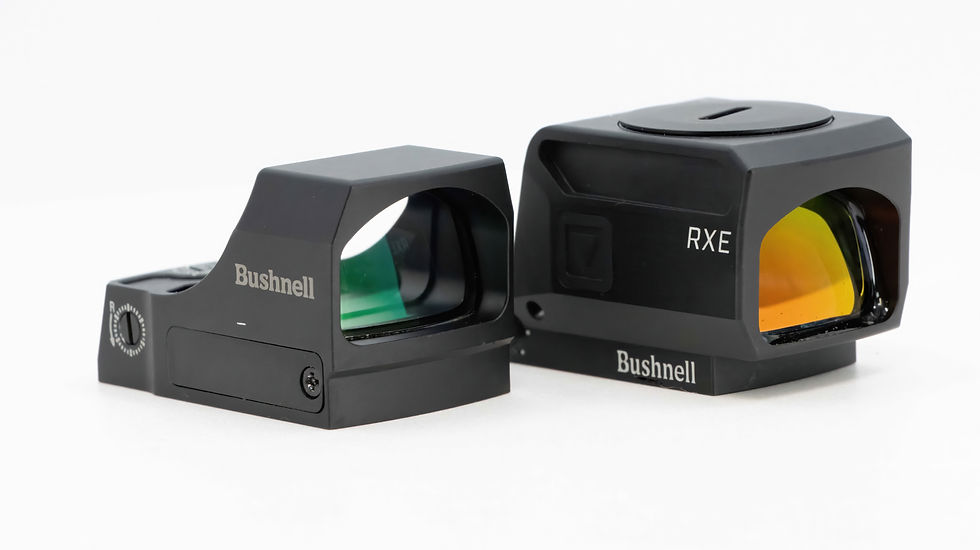
The DPP footprint has been around for a while and while recent handgun trends have folks looking for guns too small for this footprint, it remains a staple on larger firearms. Both of Bushnell's optics in this pattern have shake-awake abilities and don't require dismounting the optic to change the battery, but the similarities end there for end-user application.
The RXS-10 is a conventional open-emmitter with a 3moa green or red dot (two separate options). The RXE is an enclosed dot with three reticle options on one device of a dot, circle-hash, or circle-hash + dot. In my opinion that makes the RXE the choice for harder-use. all-weather shooting and RXS-10 the option for more casual fair-weather shooters. I've also found the circle+dot style reticles to accelerate my target aquisition when moving or transitioning targets.

Pairing the RXE with a larger carry pistol like the BUL Armory EDC seems like a natural fit.
RXS-10 | RXE | |
Reticle | 3moa Green or Red (model) | 3moa dot, 40moa circle-hash |
Battery Type | CR2032 | CR2032 |
Battery Life | 15,000hrs on mid setting | 35,000hrs on mid setting |
Brightness Settings | 8 | 10+2NV |
Weight w/Battery on my scale | 1.4oz | 1.9oz |
MSRP | $149.95 | $349.95 |
Market Prices As of 8MAY26. Check links for current pricing


Egads, but I must throw some shade upon Bushnell from my two years old experience. I have NO RECENT experience but what I learned two years ago astounded me. Bushnell is NOT an optics house anymore; it is a GIANT Chinese department store MOSTLY devoted to Asian-made sports-fashion clothes and boots and gear to outfit and decorate your mountain hunting lodge. Actual "sporting goods" is only a small hidden part of the empire! I bought a close-out sale from an independent big internet store of the Bushnell "Lil' p" prism "scope" when the full retail price was in the mid two hunnerts. It turned out to be TINY, more of a fancy elevated rear sight with barely any adjustment…