


Henry Big Boy Carbine Color-Case Hardened

Updated: Mar 2
*Some of the external links found on this website are affiliate links. Those links use cookies to generate revenue and fund continuation of this website. By clicking an external link you are consenting to a temporary cookie, by purchasing from that link you are supporting this website. To opt out of cookies do not click external links.

Benjamin Tyler Henry patended the first reliable lever-action rifle in 1860 and it has been a symbol of Americana ever since. Images of the American Civil War, Westerward expansion, classic Western movies, and the rear-window rack of an old farm truck come to mind. Even in the era of gas-operated semi-automatic firearms there's still a draw to the classic lines of a lever-action rifle and the deliberateness of running the lever before making a shot that counts.

My experience with Henry rifles has been a mixed one. In the mid 20-teens when it seemed every channel on YouTube had one I was somewhat put off by the spamming of content, but also curious to experience one for myself. Fresh out of fighting two wars in the Army, and a year spent teaching defensive shooting to my now civilians, I didn't care for tube-load only models; considering them both tactically unsound (not easy to top off ammunition) and an unnecessary annoyance for loading, possibly even a safety concern during unloading if not done properly. I asked Henry to let me know when they introduced a side-loading option.

Henry later did and I had the opportunity to try a handsome Golden Boy in 30-30 Winchester; a classic cartridge that was originally introduced with a lever-action rifle. Unfortunately the action of that particular rifle was very stiff and clunky. When I asked Henry enthusiasts about it I was told to simple break the rifle in with 200-300 rounds. That was not something I was willing to do with ammunition at the time costing over $1/shot. Fast forward the better part of a decade and it was time to give Henry a try again.

What is it? The Big Boy series of rifles and carbines are available in several calibers and finishes. The model I opted for specifically is a color-case hardened, large-loop carbine chambered in .357 Magnum/.38 Special. This caliber choice was made part in order to pair well with the Henry Big Boy Revolver as a campanion and part to keep ammunition costs low as the calibers are not what I usually keep a supply of. I opted for the large loop partially for aesthetics, but also because I have large hands and didn't like the idea of raking knuckles to get my fingers into and out of the loop.
Another note about Henry rifles is their motto and ethic of "Made in America or Not Made At All," A rare and refreshing attitude that reassures customers that their dollar will remain a dollar.

Who's it For? Over 160 years after the first commercially-successful lever-action rifle the platform retains popularity. Some of the options choices I made were for aesthetics, and I bet aesthetics are part of the overall appeal of lever guns, but the thin frame and easy-handling nature of lever-actions is another appeal, along with the ability to use the same ammunition in both rifle and revolver. Another aspect is fun; there is a unique satisfaction to running a lever, especially as it smoothens out and you learn the right amount of pressure for a good, authorative, and smooth "shuck-shuck".

Is it worth having a carbine in .357 Magnum and .38 Special? I was curious, and also curious of the user-manual's warning that some .38 Special loads may be too short to reliably run in this carbine. To learn more about the calibers, and get a better feel for the guns I gathered 13 different loads of .38 Special, .38 Special+p, and .357 Magnum loads and chronographed them through both the Henry Big Boy Carbine and Big Boy Revolver. The results were interesting with the combinations producing from just over 200 ft/lbs to over 1,000 ft/lbs! Those results can be seen HERE .
Take a Look at the Henry Big Boy Carbine in the tabletop video below. This review has a bit of a different format as it's not the type of firearm I typically work with, and I do not feign expertise when I am still learning. Rumble Link
Specifications:
Model Number: H012GMRCC
Action Type: Lever Action
Caliber: .357 Magnum/.38 Spl
Capacity: 7 Rounds
Barrel Length: 16.5"
Barrel Type: Octagon Blued Steel
Rate of Twist: 1:16
Overall Length: 34.1"
Weight: 7.41 lbs.
Receiver Finish: Color Case Hardened Steel
Rear Sight: Fully Adj. Semi-Buckhorn w/ Diamond Insert
Front Sight: Brass Bead
Scopeability: Drilled and Tapped
Scope Mount Type: BB-RSM
Stock Material: American Walnut
Buttplate/Pad: Black Solid Rubber Recoil Pad
Length of Pull: 14"
Safety: Transfer Bar
Embellishments/Extras: Swivel Studs, Side Gate
M.S.R.P. $1,283.00
Prices around the web as of 23DEC25
Click links for current pricing and availability
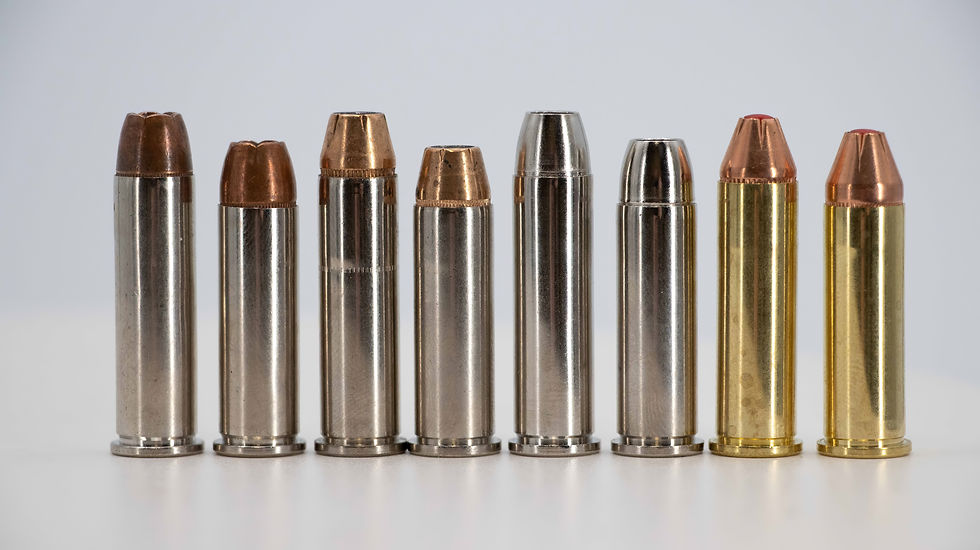
An interesting note in the manual warned of only using certain grain weights of .38 Special. This is pressumably because the case length and overall loaded length of .38 Special is shorter than .357 Magnum. I could envision a load that was too short either not feeding well into the chamber, or maybe not having enough spring pressure in the magazine tube to present correctly. Since I had gathered a sampling of .357 Magnum and .38 Special loads for the Henry Big Boy Revolver I tested them all in the Carbine for a special What's For Dinner. Because this shooting was also being done to learn more about the two calibers it was all filmed as part of my deeper dive into just how wildly different the two calibers can perform in each platform.
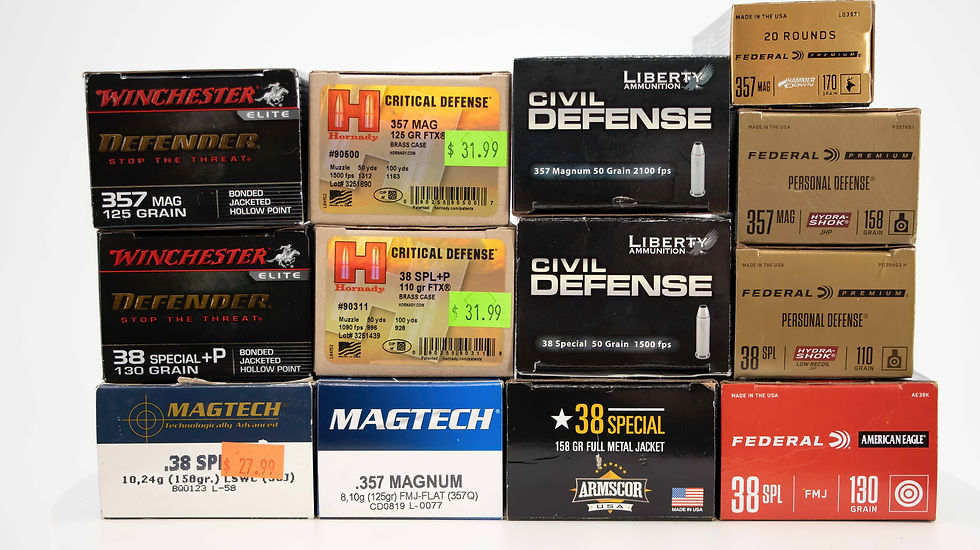
Loads Tested included:
50gr .38spl Liberty Ammunition Civil Defense $40.33 / 20 from Global Ordnance
50gr .357mag Liberty Ammunition Civil Defense $41.55 / 20 from Global Ordnance
110gr .38spl Federal Hydra-Shok $35.99 / 20 direct from Federal
110gr .38spl+p Hornady Critical Defense $30.34 / 25 from Global Ordnance
125gr .357mag Winchester Defender $34.12 / 20 from Global Ordnance
125gr .357mag Hornady Critical Defense $31.56 / 25 from Global Ordnance
125gr .357mag Magtech FMJ $32.28 / 50 at from Global Ordnance
130gr .38spl Federal American Eagle $38.99 / 50 direct from Federal
130gr .38spl+p Winchester Defender $29.47 / 20 at Global Ordnance
158gr .38spl LSWC Magtech Out of production?
158gr .38spl Armscor $24.56 / 50 at Global Ordnance
158gr .357mag Federal Hydra-Shok $39.99 / 20 direct from Federal
170gr .357mag Fderal Hammer Down $27.92 / 20 from Global Ordnance

I did not experience any major malfunctions with any of the loads. There were a couple of .38 Special loads that wanted to hang up a little during feeding, but could be remedied with a good racking. I suspect the caution in the Henry Big Boy Carbine manual is simply to ensure the easiest of times. Another note I have from that shooting experience is that while the large loop makes it easy to get one's hand into and out of the loop, it also permits the space for some momentum of the hand to build up before smashing into the loop. An annoyance at low round counts, but uncomfortable over the course of an afternoon. I've ordered the leather wrap for the loop, as well as a pic rail. Once I have those installed I'll mount an optic and return to the range for some accuracy testing.

I'm curious to know what you think an appropriate distance is for accuracy testing. I usually use 100 yards for rifles, but handgun calibers tend to drop like rocks at 100yds, and I feel it's not a representation of the firearm once the projectile is stretched beyond its useful range. Currently I'm thinking 50 yards or maybe even 25 might be more fair, especially if I stick with a simple red dot where shooter error can misrepresent the firearm at distance.

After consulting some folks more familiar with the cartridges than I, it was decided 50 yards would be about the practical limit for groupings without risking the cartridge's limitations misrepresenting the carbine's performance. I ordered a rail from Henry and attached the OSight XR; an RMR-pattern enclosed red dot.
I hit the range with the same variety of loads used in our discovery of what .38 Special, .38 Special+p, and .357 Magnum could do and used the last of it for a single 5-shot group at 50 yards with each load. The results were interesting and I think we identified some loads to prefer and others to avoid in the video below: Rumble Link


I have the same rifle too, but mines the Brass ver. And trying to keep the brass shine up, ugh. Should have got this one. Shoots well, and I got the special adapter to allow mounting an optic dot.